
Bat Spotting in Ireland: How to Use a Bat Detector
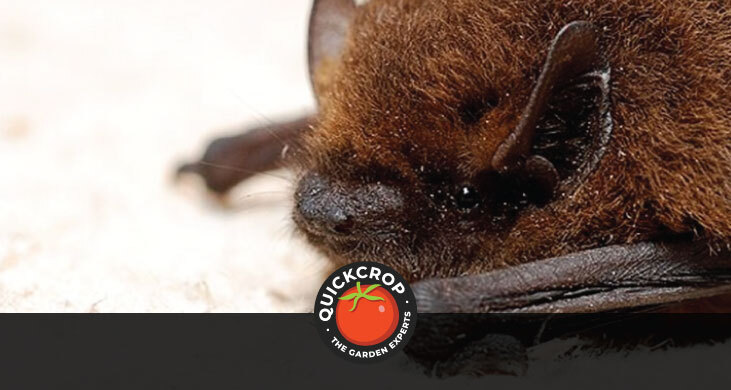
You’d be forgiven for not giving much thought to bats: they are small creatures, they only come out at night, they avoid lighting and they don’t draw attention to themselves. However, species like the Common Pipistrelle are widespread in Ireland, and they do lots of good for our ecosystem while largely avoiding the plaudits that, say, bees get.
In total there are 9 species confirmed as resident in Ireland. There has been a growing interest among wildlife enthusiasts in understanding and protecting these elusive creatures of the night, whose natural habitats have declined or are under threat.
Ireland's Bat Species:
- Common pipistrelle
- Soprano pipistrelle
- Leisler’s bat (Ireland's population is of international importance, due to its relative rarity in Europe)
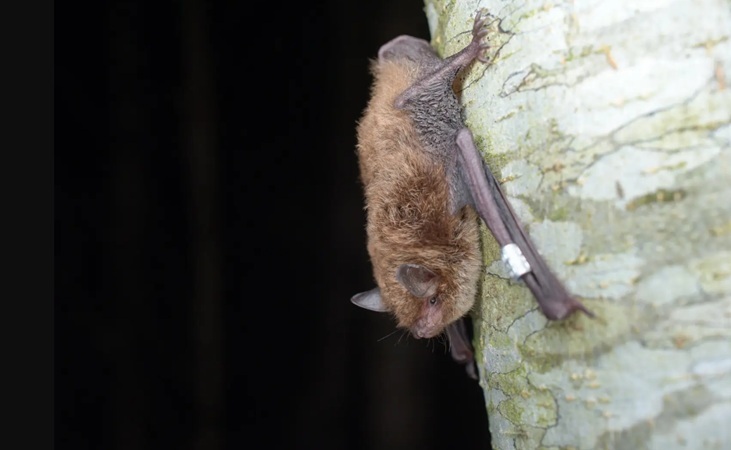
- Daubenton’s bat
- Brown long-eared bat
- Nathusius’ pipistrelle (migratory)
- Whiskered bat
- Natterer’s bat
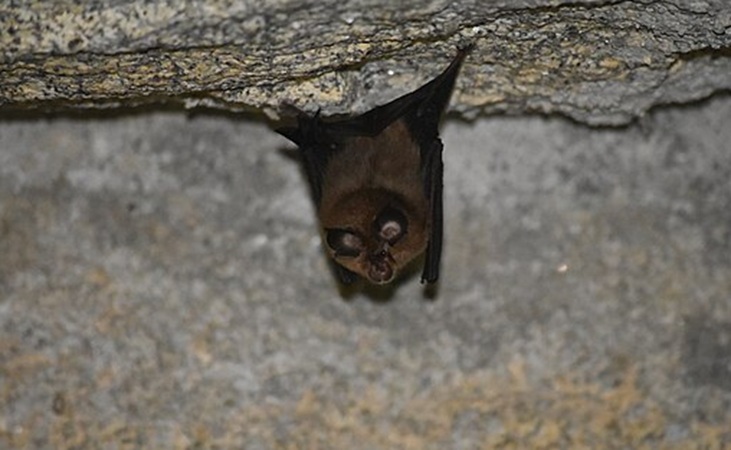
- Lesser horseshoe bat (Ireland is a stronghold for this declining bat species, with the second largest national population in Europe)
Can You Spot Bats In the Wild?
Yes you can, especially at dusk when it hasn’t gotten completely dark yet. In Ireland bats tend to emerge from their nests or roosting spots from just after to 90 minutes after sunset.
In terms of seasonality, the best time for bat spotting is between May and September, with peak activity from June to August.

Bat Tree Box - VKWS8
View ProductWhere are the Best Places to see Bats?
- near known roosts
- near woodland areas
- along waterways such as rivers and canals (in particular Daubentons bat, which is known to skim just above the water surface and feed on aquatic insects this way)
- near old buildings
The best bat calls will be captured in relatively open space, so avoid trying to record them just outside a nesting spot. This is also good practice as we should avoid disturbing nests.
All bat species in Ireland are protected under Irish and EU law. Bat spotting should always be done at a distance and without interfering with their natural behaviour.
Identifying Bat Species
While you can spot them if you look in the right places, it can be more difficult to identify the species of bat that you see, especially as they move around pretty fast. This is where bat detectors come in: these are devices that can be used by ecologists, hobbyists and beginners alike.

Magenta 4 Bat Detector
View ProductWhat to Bring when Bat Spotting:
- Bat Detector
- torch
- spare batteries
- warm clothing
- a stool
Bats and Echolocation
Bats navigate through echolocation: this is where they emit high pitched sounds that bounce off objects (if you remember playing the game ‘Ecco the Dolphin’ you will have a good mental picture of how this works).
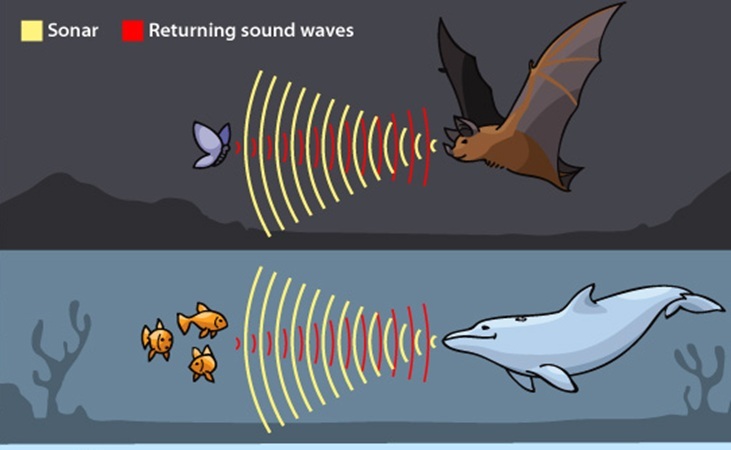
By interpreting the returning echoes, bats can determine the distance, size and shape of a given object - as well as if it is moving. As you can imagine, this enables them to seek out food sources as well as avoid obstacles and threats.
These ultrasonic calls are inaudible to the human ear, as they are in the range of 20-120 kHz. (Note that bats are also well able to make noises that humans can hear!)

Schwegler Flat Woodcrete Bat Box - 1FF
View ProductHow Does a Bat Detector Work?
A bat detector is a hand-held electronic device that captures the ultrasonic calls that bats make, and then makes them audible to the human ear.
Describing how exactly this works can get a bit technical; it also differs according to the type of device. In simple terms a bat detector will capture the bat calls with a microphone, process them electronically and then play them back at a frequency range that we humans can hear.
The most common, affordable and beginner friendly device is what’s known as a ‘heterodyne’ detector. It’s very easy to use during field work. First you will select a given frequency band. Bat calls within that range are then captured and converted.
In simple terms the device then ‘translates’ bat calls by mixing them with an internal signal, producing audible results as you go.

Woodstone Harlech Bat Box
View ProductOne drawback of using a heterodyne detector is that identification typically can’t be verified later, as the detector is primarily designed for real-time use in the field and not for lab analysis.
However, with experience, identifications can be fairly reliable particularly when combined with visual observations, habitat, and knowledge of local species.
As you can imagine, this is a very fun activity which will be particularly enjoyable for anyone with an interest in sound design, field recording and similar hobbiles.
When a bat call is played back for human ears it can sound like chirping, ‘squeaking’ or clicking. Part of the fun is how different individual bat species can sound.
An Example: Pipistrelles
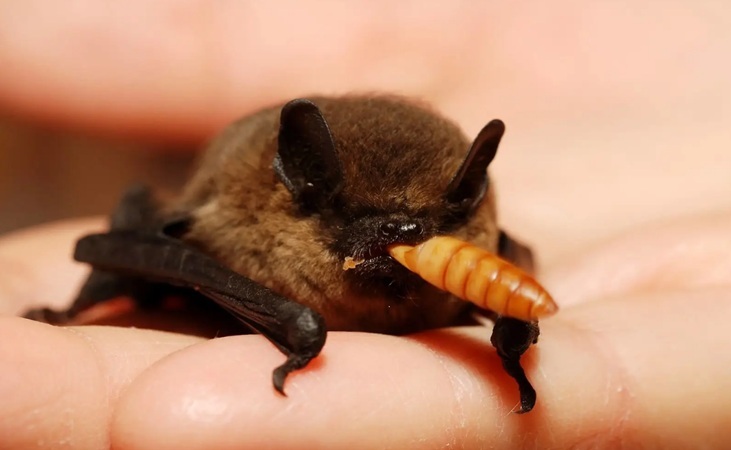
The Common and Soprano Pipistrelle are two species that can look very similar to the naked eye - so much so that they were only first recognised as two distinct species by analysing their ultrasonic calls.
Common Peak frequency: between 42-48 kHz
Soprano Peak frequency: >52 kHz
The following table (credit: Bat Conservation Trust) gives a more detailed illustration of how bats can be identified using a heterodyne detector.
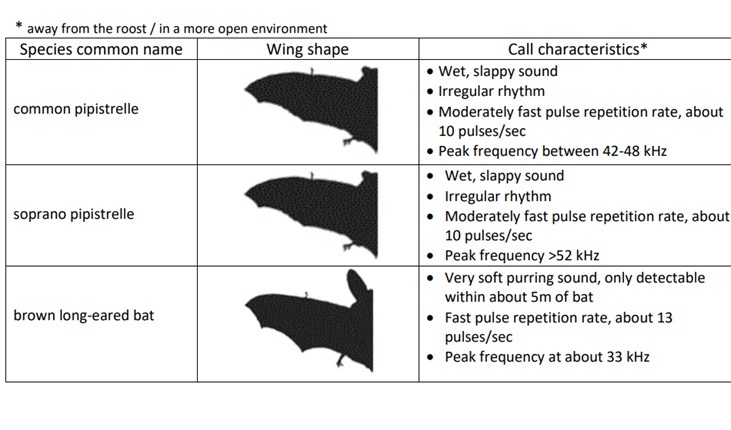
As you can see, it’s not just frequency that is taken into account. Other factors include the rhythm of the sound, the ‘pulse repetition rate’ or the peculiar sonic quality or timbre. In the case of Pipistrelle bats, the ‘wet, slapping sound’ is a result of both the conversion process (which alters the timbre) and the ‘percussive’ nature of the short calls.
The Importance of Bat Detectors
Of course, this isn’t just a pleasant way to while away an evening. Bat detectors can be an important tool in terms of monitoring bat species, studying their behaviour, or assessing the health of local ecosystems.
Magenta Bat Detectors
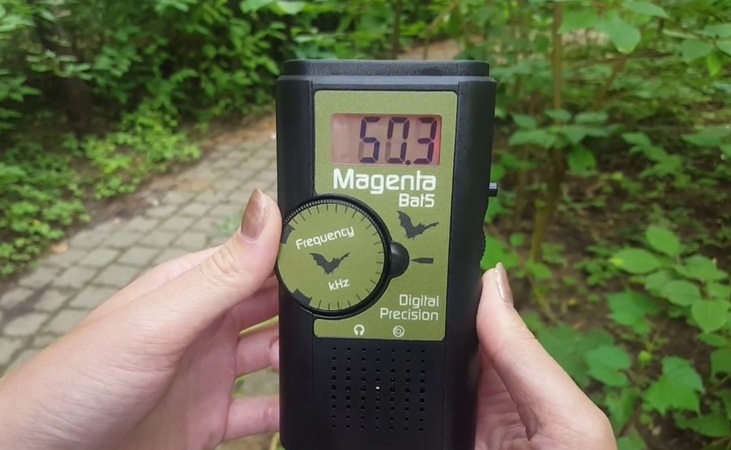
One of the most popular and widely-used heterodyne bat detectors is the Magenta, a battery-operated handheld device with two current variations.
The front of the Bat 4 Detector features a wheel-shaped dial, which you use to tune to a chosen frequency (different bat species will emit at different frequencies, although it’s important to note that there is a lot of overlap. 45 kHz is a good starting point).

Magenta 5 Bat Detector
View ProductThe Bat 5 Detector is a more recent design that features a backlit digital frequency display and an extended tuning range (10-130 kHz in comparison to 15-130 for the Bat4 device). The red light display is easier on the eyes in dark conditions.
How They Work
- When looking for a particular species you set the dial to the appropriate frequency.
- Scan the area by pointing the detector in different directions
- You can scan from side to side or up and down
- Once bats are detected, you can fine-tune the frequency to get the strongest signal.
- The Magenta converts the ultrasonic calls into sounds you can hear through either the speaker or headphones attached via the hp socket.
Other Types of Bat Detector
Frequency Division bat detectors: take the incoming calls and electronically divide the frequency (e.g. by 10), shifting them down into the audible human range in real time.
Time Expansion bat detectors: record a short snippet of ultrasonic sound and then play it back slowly, while still preserving detail and harmonics. These devices produce the most accurate reproduction of a bat call, preserving tonality and harmonics.
Time expansion detectors are the best option for detailed acoustic analysis or academic work. On the other hand they are not so suitable for quick field detection.

Schwegler Bat Box 2F (With Double Front Panel)
View ProductBat Walks
A good way of seeing how bat detecting works in practice is by joining a local bat walk. Bat Conservation Ireland, Tidy Towns groups or local bat groups will sometimes organise guided bat walks in locations across the country - particularly during Biodiversity Week or Heritage Week.
References:
"How to Watch Bats" Bat Conservation Ireland, https://www.batconservationireland.org/in-your-area/watching-bats
"Irish Bats" Bat Conservation Ireland, https://www.batconservationireland.org/irish-bats/species
Images:
Lesser horseshoe bat hanging on roof: João Manuel Lemos Lima, Wikimedia Commons CCA 4.0
Daubentons bat: Rauno Kalda, Animalia, Attribution Share Alike
Echolocation illustration: Arizona State University
Pipistrelle bat eating a mealworm: Gilles San Martin, Animalia, Attribution 3.0